Why Has My Socket Stopped Working?
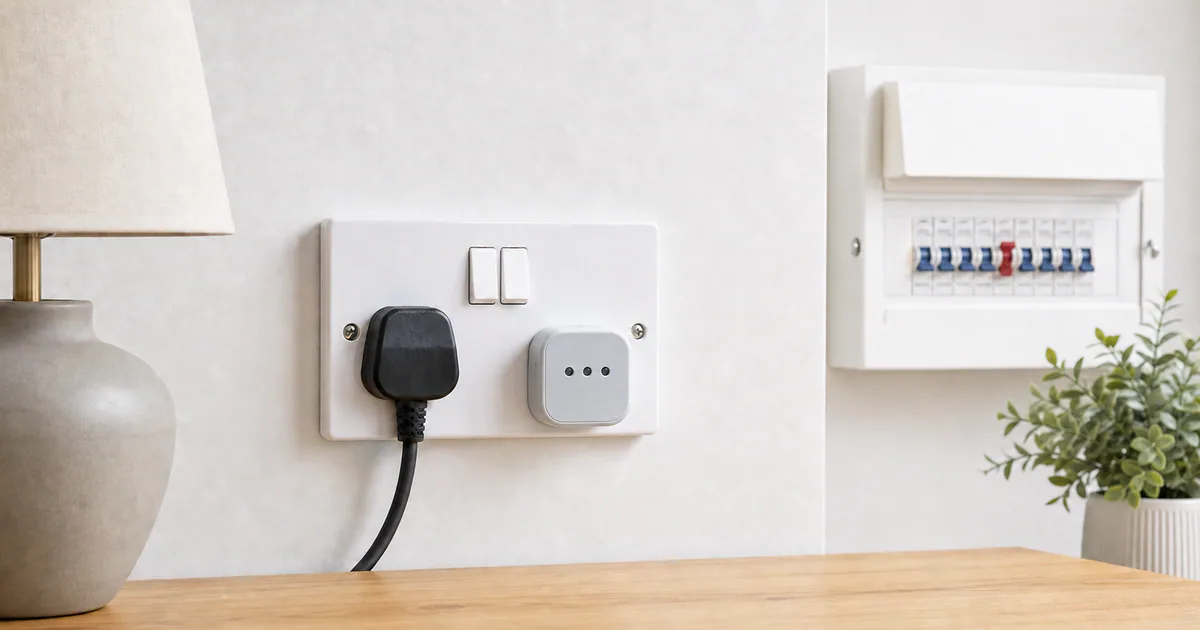
A socket that suddenly stops working does not always mean the socket itself has failed. The appliance may have a damaged plug or blown fuse, a breaker may have tripped, an upstream connection may have opened, or the whole property may be experiencing a power cut.
The safest way to narrow it down is to look at the scope of the problem without opening anything: does one appliance fail, one outlet fail, several sockets fail, or has the whole property lost power?

Safety first: A socket that appears dead is not proved safe. Do not remove the faceplate, touch conductors, use a multimeter on mains terminals, or open the consumer unit. Stop immediately if there is heat, a burning smell, buzzing, cracking, water, smoke, sparks, visible damage, or any electric shock. Use a registered electrician for fixed-wiring diagnosis and repair.
The Quick Answer
Use the pattern below as a starting point, not as a final diagnosis.
| What has stopped working? | A possible explanation | Safe next step |
|---|---|---|
| One appliance | Appliance fault, damaged lead, loose plug, or blown plug fuse | Unplug it and inspect the plug and lead visually |
| One half of a double socket | Worn or damaged socket mechanism | Stop using the entire double socket and arrange an inspection |
| One complete socket | Local socket fault or failed connection supplying it | Try one known-working low-power item only if there are no warning signs |
| Several sockets in one area | Tripped protection, failed fused spur, or open connection upstream | Check the consumer-unit indicators from the front only |
| All sockets, but lights still work | The socket circuit’s MCB, RCD, or RCBO may have operated | Follow the labelled reset instructions once, if everything is dry and undamaged |
| The whole property | Network power cut, meter issue, main switch, or installation fault | Check neighbours or the power-cut service, then call 105 if appropriate |
| Any socket with heat, smell, noise, damage, water, or shocks | Potentially dangerous fault | Keep away, switch off only if safe, and get urgent professional help |
First Check: Is the Socket Dead or Is the Appliance Faulty?
A kettle, lamp, charger, or television that will not turn on can make a healthy socket look faulty. Begin with the portable item, not the fixed wiring.
- Switch the socket off and unplug the appliance.
- Look at the plug and flexible cable without taking the plug apart.
- Check for cuts, crushed insulation, exposed wires, loose pins, melted plastic, scorch marks, or a burning smell.
- If the item looks undamaged, try a simple known-working low-power item, such as a lamp, in the suspect socket.
- Try the original appliance in a known-working socket only if its plug and cable are undamaged and it did not cause a breaker or RCD to trip.
If the known-working item operates, the original appliance or its plug is the likely problem. Stop using any item that is damaged, smells hot, trips protection, or behaves intermittently when its cable moves.
Electrical Safety First’s plug and fuse guidance recommends checking plugs and cables after unplugging them. If you find damage, stop using the item and contact the retailer, manufacturer, or a qualified repairer.
Work Out How Much of the Property Is Affected
The boundary of the fault is one of the most useful clues you can collect safely.
One Outlet on a Double Socket
If one side works and the other does not, the accessory may have a worn switch or damaged internal mechanism. Stop using the entire double-socket accessory rather than continuing with its working side. Do not keep moving the plug or switch to make it work temporarily. Intermittent contact can produce heat even if the appliance comes back on.
One Socket Only
One dead socket can result from a local accessory fault, a loose or overheated connection, cable damage, or a problem with the connection feeding that point. A dead socket does not prove its conductors are isolated; another conductor or an unexpected feed may still be live.
Several Sockets in One Room or Area
Several dead sockets often point farther upstream. They may share a radial circuit, sit downstream of a fused connection unit, or be affected by an open connection elsewhere on the circuit.
Look for an obvious wall-mounted fused spur or isolator that normally controls the affected equipment, but operate only its external switch. Do not remove its cover or replace a fuse if there are signs of heat, water, or damage.
For the difference between common circuit layouts, read Ring Circuit vs Radial Circuit.
All Sockets, but the Lights Still Work
Lighting and socket circuits normally have separate protection. If lights work but all sockets are off, an MCB, RCD, or RCBO serving the socket circuit may have operated.
That operation is a symptom, not the cause. It may have responded to a faulty appliance, damaged cable, water ingress, overload, short circuit, or earth leakage. The MCB tripping guide and RCD tripping guide explain those patterns in more detail.
The Whole Property Has Lost Power
Check from a safe position whether neighbouring properties or street lighting are also affected. If they are, or a network outage is shown for your postcode, it is probably not an individual socket fault.
Ofgem advises contacting the local electricity network operator for a network power cut. In Great Britain, calling 105 connects you to that operator; a faulty electricity meter should be reported to your energy supplier. See Ofgem’s power-cut guidance.
Check the Consumer Unit From the Front Only
You do not need to remove a consumer-unit cover to see whether a device has operated.
Before approaching it, stop if the unit is wet, damaged, unusually hot, buzzing, smoking, or smells burnt. Do not touch it in those conditions.
If it appears normal:
- Unplug portable appliances from the affected sockets where it is safe to do so.
- Read the circuit labels and look for an MCB, RCD, or RCBO whose handle or indicator differs from the others.
- Follow the manufacturer’s or consumer unit’s labelled reset instructions.
- Make only one reset attempt.
- If the device will not reset, trips again, or operates when a particular appliance is connected, leave it off and arrange an inspection.
Never hold a breaker in the on position or repeatedly reset it. Re-energising an unresolved fault can restore power to damaged equipment.
If you are unsure which device you are looking at, What Is an RCBO? explains the difference between MCBs, RCDs, and RCBOs.
Common Reasons a Socket Stops Working
1. The Appliance or Plug Has Failed
A blown plug fuse, failed appliance component, damaged cable, or loose plug connection can stop one item while the socket remains healthy. If a replacement fuse blows again, do not fit a larger one or keep replacing it. The appliance needs investigation.
2. An MCB, RCD, or RCBO Has Operated
An MCB responds to overloads and short-circuit current. An RCD responds to certain leakage imbalances, while an RCBO combines both types of protection for one circuit. None of these devices detects every possible electrical fault.
3. The Socket Accessory Is Worn or Damaged
Socket switches, shutters, contacts, and terminals can deteriorate. Plugs that feel loose, switches that crackle, or power that changes when the plug moves all require professional attention.
4. A Connection Has Opened Upstream
A loose, overheated, or broken conductor can interrupt power without creating the high current needed to trip an MCB. This is one reason a breaker can remain on while a socket is dead.
An open circuit stops current along the affected path. It is different from a short circuit, which creates an unintended low-resistance path and often causes protection to operate. Read Short Circuit vs Open Circuit for a visual explanation.
5. A Fused Connection Unit Has Failed
Some sockets, boilers, outdoor equipment, and other fixed loads are supplied through a switched fused connection unit. A blown fuse, failed switch, or damaged connection there can remove power downstream. Identifying the external switch is a reasonable check; opening or rewiring the unit is not.
6. A Ring Final Circuit Has a Broken Conductor
A broken ring does not always make a socket stop working. Many sockets may continue to operate because the remaining cable still supplies them from the other direction. That can hide the fault while changing how current is shared around the circuit.
A basic plug-in tester may show an apparently normal result even though the ring continuity is broken. Proper ring-final testing requires an electrician and suitable test equipment. The ring final circuit testing guide explains what those professional tests are intended to establish.
7. Water or Moisture Has Entered
Outdoor sockets, kitchens, utility rooms, garages, and recently flooded areas need particular caution. Do not use a socket that is wet or has been exposed to flooding. Switch off only if the consumer unit can be reached and operated safely, then have the installation inspected before reuse.
Electrical Safety First provides specific electrical safety guidance after a flood.
8. There Is a Supply or Meter Problem
If the entire installation is off and no local protective device explains it, the cause may be outside the socket circuit. A network operator handles power cuts affecting the distribution network; the energy supplier handles meter-related faults.
What a Plug-In Socket Tester Can and Cannot Tell You
A plug-in tester is useful for a limited first check. Depending on the model, it may indicate that voltage is present and flag some basic conductor arrangements.
It cannot prove that a socket is safe.
Plug-in testers may miss:
- Loose or overheating connections
- A broken ring-final conductor
- Poor insulation resistance
- Some neutral and earth faults
- An earth path that exists but is not good enough for safe fault protection
- Problems that appear only under load
The HSE warns that many socket testers cannot detect certain faults and may indicate that a socket is safe when it is not. Electrical Safety First’s Best Practice Guide 8 explains the capabilities and limitations of different socket-outlet test devices in more detail.
Treat a tester result as one clue. A reassuring light pattern is not a certificate, and no lights do not prove the conductors are safe to touch.
Warning Signs That Make the Problem Urgent
Stop using the socket and seek urgent help if you notice:
- Burning, hot-plastic, or unusual smells
- Buzzing, crackling, popping, or sizzling
- Smoke, sparks, or visible arcing
- Scorch marks, discolouration, melting, or cracking
- A plug or socket that is visibly overheating
- Any electric shock or tingling sensation
- Water near or inside electrical equipment
- Repeated breaker, RCD, or RCBO operation
- Power cutting in and out when a plug, cable, or switch moves
If it is safe to reach a normal, dry consumer unit without approaching damaged equipment, switch off the affected circuit or main supply. If it is not safe, keep everyone away and call for help. For smoke or fire, leave the property, stay out, and call 999.
If someone receives an electric shock, disconnect the supply at the mains only if you can do so safely. Do not approach or touch the person while they may still be in contact with electricity. Once the supply is off, call 999 if they are not breathing, and seek medical help after any electric shock. Follow the NHS first-aid guidance for domestic electric shock.
HSE guidance says an obviously defective part of an installation should be de-energised until repaired. Electrical Safety First similarly recommends prompt investigation of burns, arcing sounds, blown fuses, and repeated breaker operation.
What an Electrician May Check
The exact investigation depends on the pattern you observed. A registered electrician may check:
- The socket faceplate, switch, contacts, and terminal condition
- Voltage and polarity at the affected point
- Continuity of live, neutral, and protective conductors
- Ring-final continuity where applicable
- Insulation resistance
- Earth fault loop impedance
- Connections at upstream sockets, junctions, and fused spurs
- The operation and condition of the MCB, RCD, or RCBO
- Signs of heat damage or water ingress
These tests work together. A single plug-in indication cannot replace them. Use Electrical Safety First’s registered electrician finder when fixed wiring needs diagnosis or repair.
What If You Rent Your Home?
Report the fault to your landlord or managing agent promptly and in writing. Include which sockets are affected, when the problem began, whether protection tripped, and whether there was heat, smell, noise, water, or visible damage.
Do not remove the socket or arrange an unapproved wiring repair. If there is immediate danger, follow the urgent guidance above rather than waiting for a routine appointment. The landlord electrical safety guide explains the wider inspection responsibilities for rented homes.
Explore a Dead Socket Safely in ElectraSim
ElectraSim cannot inspect your home or prove a real socket safe. It can show why an open path may remove power without producing the current that trips a breaker.
- Open the RCD and socket guided circuit.
- Follow the live and neutral paths from the source, through the RCD, to the socket branch.
- Clear the template’s deliberate earth-fault warning in Fault Mode.
- Add a wire break to the live feed serving the socket.
- Run the simulation and observe which downstream path is no longer energised.
- Move the break upstream and downstream to compare how the affected area changes.
This is a learning exercise, not a procedure for testing mains wiring. The useful lesson is the pattern: the location of an open path determines what loses power.
Try the socket fault exercise in ElectraSim ->
Frequently Asked Questions
Can a dead socket still be dangerous?
Yes. An open neutral, damaged connection, unexpected supply, or incomplete isolation can leave conductors dangerous even when an appliance will not run. Only proper isolation and testing can establish that equipment is safe to work on.
Why is the breaker still on if the socket is dead?
A breaker needs a particular fault condition to operate. A broken conductor or failed local mechanism may simply stop current rather than create an overload or short circuit, so the breaker can remain on.
Why does one socket work while the next one does not?
The failed point may have a damaged accessory or connection, or it may be beyond an open connection in the circuit. Do not assume the nearest working socket identifies the fault location exactly; circuit routes are not always obvious from room layout.
Can I rely on a plug-in socket tester?
No. It can identify some conditions, but it cannot prove a socket safe and may miss serious faults such as a loose connection or broken ring conductor.
Should I reset a tripped breaker or RCD?
Only if the consumer unit is dry and undamaged, there are no warning signs, and you can follow its labelled instructions safely. Unplug portable appliances on the affected circuit first and make one attempt. If it trips again or will not stay on, leave it off and call an electrician.
Should I replace the socket myself?
Not on the basis of symptoms alone. A dead socket may be caused elsewhere, and fixed-wiring work requires safe isolation, correct connections, inspection, and testing. A registered electrician can find the cause and verify the repair.
Key Takeaways
- First separate an appliance problem from a socket, circuit, or supply problem.
- Never open a socket because it appears dead.
- Use only visual checks, a known-working low-power item, and front-panel consumer-unit checks.
- Reset a protective device no more than once; leave it off if it operates again.
- A breaker can remain on when an open connection stops a socket working.
- A plug-in tester can provide clues but cannot prove a socket safe.
- Heat, smell, noise, damage, water, shocks, smoke, sparks, or repeated tripping require urgent attention.
- Use a registered electrician for fixed-wiring diagnosis and repair.
The most useful information you can give an electrician is the pattern: what stopped working, what still works, what happened immediately beforehand, and whether any warning sign appeared.
See It All in Action
Build and simulate the circuits from this article for free in your browser. No installation, no sign-up.
Open ElectraSim Free